Why a monthly review is too late to operate on
A monthly report describes a month you can no longer change. The estate has already run, and the spend is already incurred, by the time the invoice lands. Operating continuously is the only thing that closes the gap.
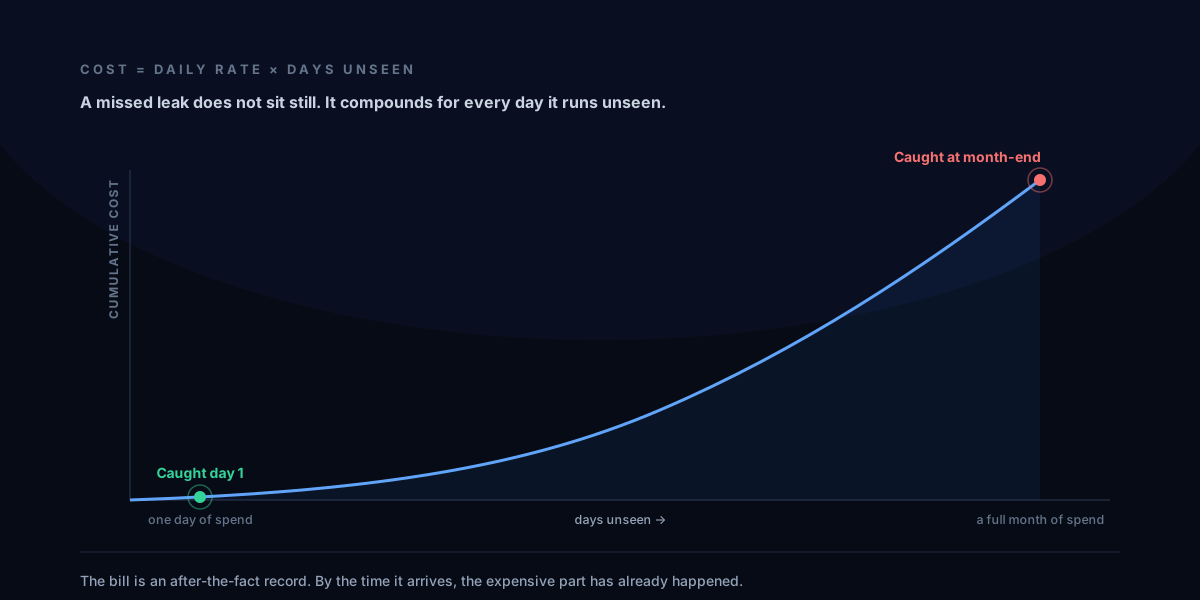
A monthly cloud bill is a record of decisions already made. By the time it arrives, the money is spent, the resources have already run, and the only remaining task is to explain the total. Reviewing cost once a month appears disciplined on a reporting calendar, but the information arrives after every action that produced it. The detail is accurate and complete, and it is reported too late to change the outcome it describes.
This is not a criticism of the teams performing the review. It is a consequence of when the information becomes available. The most rigorous month-end review is still a review of a period that can no longer be changed.
Cost accrues continuously, not at month-end
The underlying problem is timing. Cloud cost does not appear at the end of the month. It accrues continuously, by the hour and by the gigabyte, every minute of every day. The moment a workload doubles, a job begins looping, a queue backs up, or an environment is left running after a test, the rate of spend increases and stays elevated until someone notices and intervenes. The bill is simply where all of those hours are finally totaled and presented, often weeks after the first was charged.
The number on the invoice is therefore not the event. It is the sum of thousands of small events that already occurred. By the time it is read, the only thing left to manage is the explanation.
The gap is where the money goes
Between the moment a cost begins and the moment a person notices it sits a gap, and that gap is where the money goes. A dashboard does not help on its own, because a dashboard waits to be looked at. People open dashboards when they remember to, or when they are already concerned, not in the quiet hours when a problem is just beginning. A report does not help either, because it does not arrive until the period is closed. Between the two runs a stretch of days, sometimes weeks, in which a problem accrues unseen.
This is why expensive incidents are rarely expensive because the rate was high. They are expensive because the rate ran for a long time before anyone checked. A small leak that runs for three weeks costs far more than a large spike caught and resolved the same afternoon. Magnitude attracts attention. Duration does the damage.
The arithmetic is direct
The cost of an undetected anomaly is, to a close approximation, its daily rate multiplied by the number of days it runs before it is detected. That is the entire model, and its implication is uncomfortable. The variable you most control is not the rate. It is the time to detection.
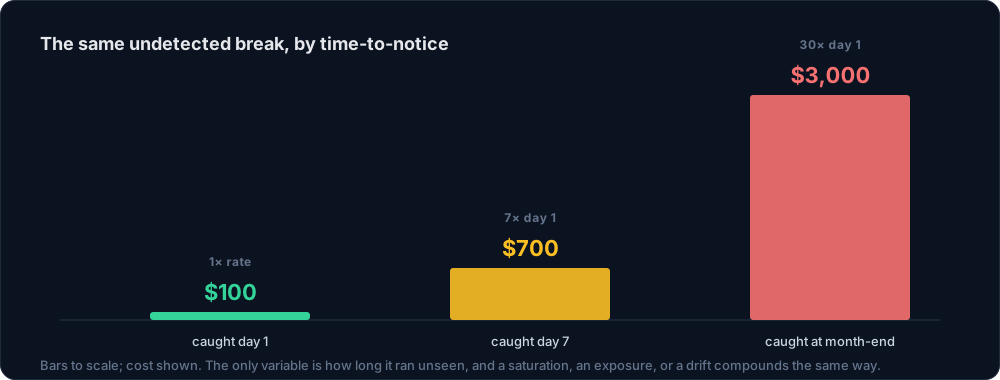
A leak adding a hundred dollars a day costs a hundred dollars if it is caught on day one, seven hundred if it is caught after a week, and three thousand by the end of the month. Same leak, same rate, same root cause. The only variable across those three figures is how long it ran unseen. Negotiating a better unit price might reduce the rate by a few percent. Cutting time to detection from thirty days to one reduces the cost of that incident by roughly ninety-seven percent, and it is entirely within your control.
Why a budget alert does not fix it
The common response is a budget alert: set a monthly threshold and receive an email when it is crossed. This does not close the gap, for two reasons. First, a monthly budget can only fire once most of the money is already spent, near the end of the period, when the spend is nearly committed. The alert confirms the problem after the period it covers is effectively over. Second, it carries a single number for the entire account, so it cannot distinguish a genuinely busy day from the first day of a real problem. Set it low and it fires on every busy day until people mute it. Set it high and it stays silent through a runaway. In either configuration it reports late, and lateness was the entire problem.
It compounds across an organization
One slow-to-detect gap is a problem. An organization runs dozens at once: many teams, many accounts, and many independent ways for a number to begin drifting outside the hours anyone is actively reviewing it. Month-end review does not scale to that. It is a single human pass over an enormous surface, performed once, weeks late. The surface that requires monitoring is far larger than any review cadence a person can sustain. This is the structural reason the waste figure has barely moved in years despite cost being a stated priority. The constraint was never a lack of attention. A monthly review cannot keep pace with spending that accrues every minute.
What actually closes the gap
What closes the gap is not a faster report. It is continuous monitoring with a learned baseline of normal behavior, combined with standing access to act on the resource the moment the curve bends rather than the moment the period closes. A system that monitors every number continuously, holds a reference for what each should be, and responds within the hour one begins to drift: it traces the increase to the specific resource behind it, identifies the cause, and, because it is connected to the account rather than only the invoice, stops or holds that resource when the action is reversible and within your guardrails, and routes it to the person who can decide when it is not.
That distinction is the central point. A report can only tell you the spend occurred. An operator with access can reach the resource, contain the spend, and log exactly what it changed and why. A report and an operator differ in the same way after-the-fact analysis differs from a control that intervenes while the spend is still running. Both are accurate. Only one of them can act while there is still time to change the result.
And this is not only about cost. A saturating workload, a newly opened path to the internet, a resource that has drifted out of policy: each accrues the same way, continuously, in the gap between when it starts and when a person next looks. A monthly review is late for all of them. The only thing that closes the gap, for reliability and security and governance as much as for cost, is an operator watching every signal continuously and acting on the resource the moment one bends.
See it on your own estate
We connect to your accounts, map every resource inside them, and show you what PYXIS3 would operate and the savings it would realize in the first month, before you pay anything.
Book a demo