Sizing commitments to your real capacity floor
Reserved capacity is the deepest discount the cloud offers and the easiest to convert into stranded capacity you cannot cancel. The determining factor is how you size it to your real usage floor.
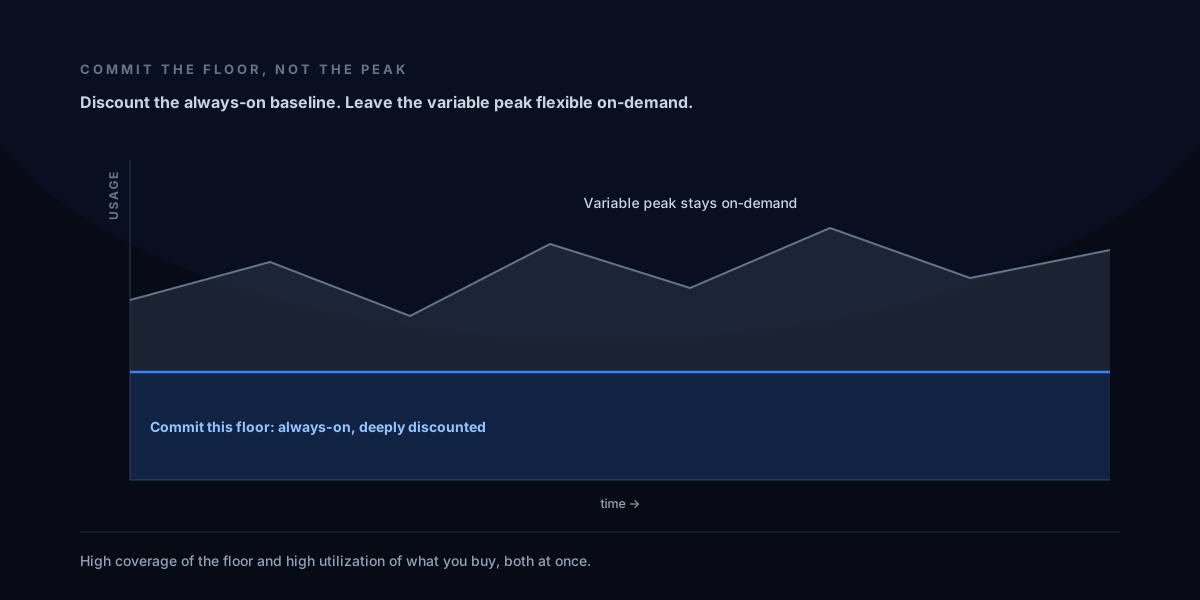
Commitment discounts are the largest discount the cloud offers and, at the same time, the one most likely to work against you. The offer is straightforward: commit to using a steady amount of capacity for one or three years, and in return pay far less per hour than the on-demand rate. For the portion of your usage that runs continuously, this is the single largest lever available, larger than any amount of cleanup. It is also where disciplined teams can create a new form of waste. A commitment to capacity you do not end up using is money spent on nothing, bound by a contract you cannot easily exit.
That dual nature is the central point. Used well, commitment is the deepest discount available. Used carelessly, it converts a discount into a new, harder-to-remove form of the exact waste you were trying to eliminate. The difference between the two outcomes is entirely a matter of how you size the commitment.
The two numbers: coverage and utilization
Two numbers govern this, and they work against each other when either is optimized alone. Coverage is the share of your eligible usage that sits under a commitment rather than paying full on-demand rates. Utilization is the share of what you committed to that you actually consume. Each is easy to maximize on its own and risky in isolation.
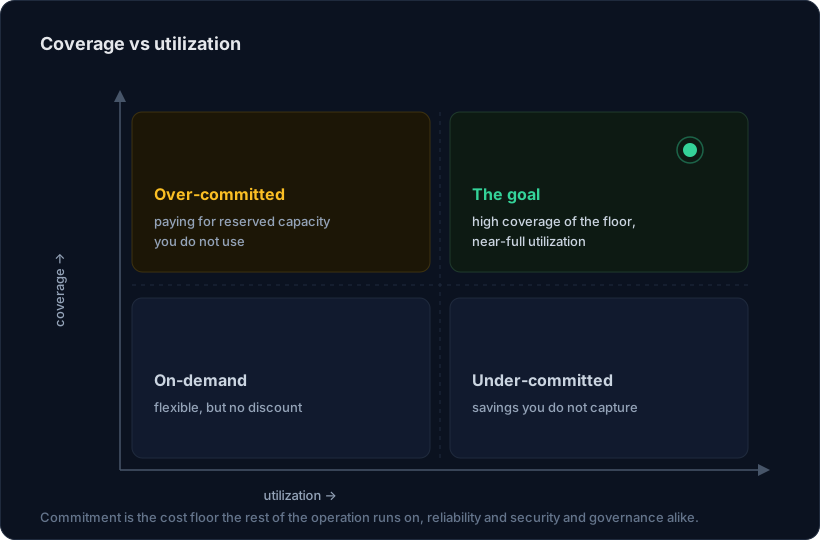
Optimize coverage alone and you commit aggressively. Coverage appears excellent on the dashboard until your usage shifts and utilization collapses, leaving you paying for reserved capacity that is no longer used. Optimize utilization alone and you commit so conservatively that most of your steady baseline still pays list price, leaving the largest discount in the cloud mostly untaken. The target is the quadrant where both are high at once: broad coverage of the steady portion and near-full utilization of everything you committed to. Any other position forfeits money, either unrealized or locked in a contract you cannot use.
Commit to the floor, not the peak
The single principle that prevents this failure is to commit to the floor of your usage, never the peak. Usage has two layers. A baseline is always present, hour after hour, nights and weekends included: the portion of your infrastructure that never drops to zero. Above it sits a variable layer that rises and falls with traffic, jobs, and seasons.
The baseline is what you commit, because it is the portion you are certain to use for the length of the term. The variable layer stays on-demand or on flexible, short-term arrangements, because committing to a peak you only occasionally reach guarantees you pay for idle reserved capacity every hour you sit below it. Identify the floor accurately, commit to that, and leave the rest uncommitted. The difficulty is entirely in locating the true floor, which requires monitoring real usage over time rather than estimating from a single busy period.
Flexibility is worth a modest premium
The temptation is to pursue the deepest possible discount, which usually means the longest term and the narrowest, most specific commitment. That is the wrong default in most cases. Shorter terms and broader, more flexible commitment types discount slightly less, but they survive change, and change is the norm. A team that re-architects, migrates, adopts a new instance family, or simply grows in an unpredicted direction should not be holding a three-year commitment on the wrong shape of usage.
For most teams operating at a fast pace, the slightly smaller discount on a flexible commitment costs less in the end than the maximum discount on a rigid one, once you account for the rigid commitments that drift out of use and strand. The headline rate is not the figure that matters. The figure that matters is what you net after waste, and flexibility reduces the waste.
Start conservative, then add in layers
If you are uncertain where the floor truly sits, the safe direction to err is downward. Commit to a conservative portion of the baseline first, confirm that utilization holds at or near full over a sustained period, then add another layer on top of the portion that has proven steady. This layered approach trades a small amount of discount in the early months for near-certainty that you never hold reserved capacity you cannot use. Adding commitment to usage that has demonstrated it is permanent is far easier than unwinding a commitment made on an optimistic estimate. Under-committing costs a slightly smaller discount this month. Over-committing costs real dollars every month until the term ends.
Why this lever requires human approval
This is precisely why we treat commitment as a lever we recommend rather than one we execute on our own. The pattern matches the rest of the system: we monitor your usage long enough to identify the genuine floor, size a recommendation to that baseline, present the discount and the term it implies in plain numbers, and let you approve it. Retiring an unattached disk is a cleanup that is fully reversible and safe to run automatically. Committing your account to a multi-year financial obligation is a different kind of decision, and it should be made by a person reviewing the same numbers we are, deliberately, with the term and the trade-off in view. Automation should clear the routine, reversible waste. It should not sign multi-year contracts on your behalf.
Commitment is the one lever that holds money over a long horizon, which is why it is the one handed to a person. The rest of the operating surface moves faster and more reversibly: reinforcing a workload before it saturates, closing an exposure the moment it opens, bringing a resource back into policy as it drifts. Sizing a commitment well is the financial floor under all of it, the steady base the estate runs on, and getting that base right is what lets everything above it, cost and reliability and security and governance alike, stay flexible.
See it on your own estate
We connect to your accounts, map every resource inside them, and show you what PYXIS3 would operate and the savings it would realize in the first month, before you pay anything.
Book a demo