The levers of autonomous infrastructure operations
Finding inefficiency is the easier half. Acting on it without disrupting what teams depend on reduces to a handful of operations, separated by risk.
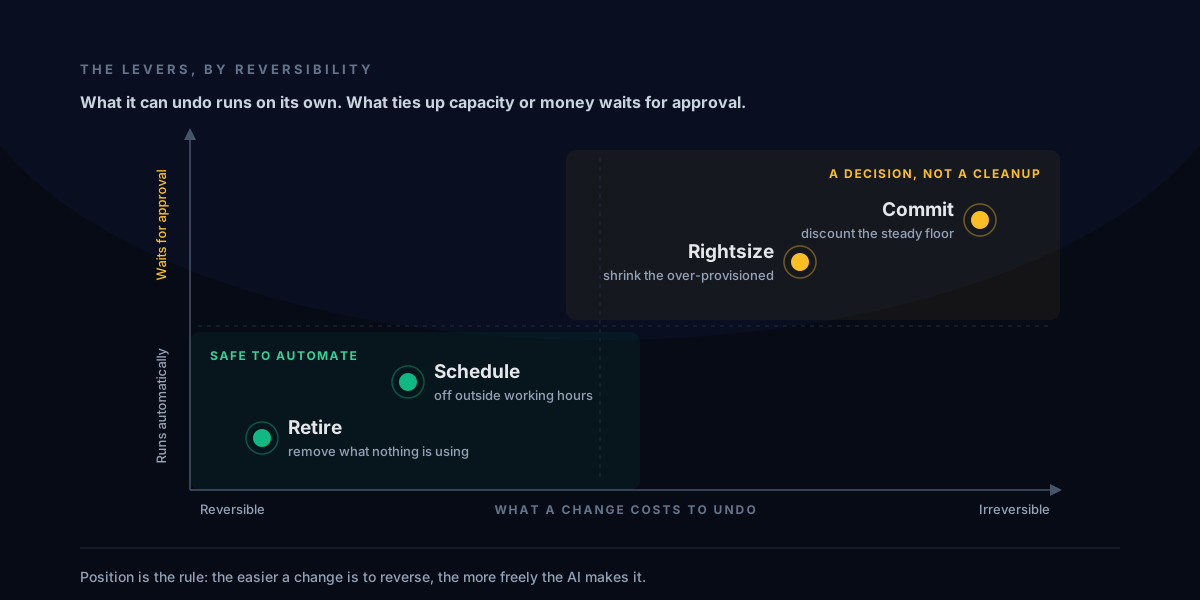
Finding inefficiency receives most of the attention, but it is only half the work, and the easier half. The other half is acting on it, which means reaching into the account and changing the resource without disrupting anything a team depends on. That is where most programs stall. It is also the heart of the shift now underway across the industry, from dashboards that wait to be read toward agents that observe, decide, act within guardrails, and learn. The acting side is not open-ended. It reduces to a small, well-understood set of actions. They cover the large majority of cloud inefficiency, and they differ along two axes that matter: how much risk the action carries, and whether it should run autonomously or wait for human approval. PYXIS3 has the access to operate each of them, and on top of them it runs three more that keep the estate sound rather than cheap. What follows is how it decides which to run automatically and which to present for approval.
Retire: delete resources that nothing is using
The safest lever is deleting resources that nothing is using: unattached disks, snapshots past their useful life, public IP addresses bound to nothing, and load balancers and gateways with no backend behind them. There is no performance trade-off, because by definition nothing relies on these resources. They are pure cost with no corresponding benefit. The saving is realized the moment they are removed, and for anything backed by a snapshot or a backup, retiring is reversible within your retention window if a resource is needed again.
Because the risk is low and the saving is clean, Retire is the lever safest to run autonomously, within a spending limit you set. The obstacle for most teams is not risk. It is that no one has the time to locate every orphaned resource manually.
Schedule: stop resources outside the hours they are used
The second lever stops resources outside the hours they are used, which in practice means non-production environments outside working hours. The arithmetic from the analysis of distributed waste applies directly. An environment used during business hours is genuinely needed for roughly fifty hours out of the week's one hundred and sixty-eight, and the remainder is paid-for idle time. Scheduling it off on nights and weekends removes that idle cost without affecting how the team works, because the environment was not in use while it was off. It is reversible by design: the schedule restores the environment the following morning before the team begins work.
Like Retire, Schedule is safe to automate. The constraint was never risk. It was configuring the schedule once, which is exactly the kind of one-time task suited to automation.
Rightsize: reduce an oversized resource by a tier
The third lever, rightsizing, reduces an over-provisioned resource by a size when its utilization is consistently low. Because the price ladder roughly doubles at each step, dropping a single tier on a chronically underused instance or database is a large saving on that resource, not a marginal one. Rightsize warrants more care than the first two levers, because it changes live capacity rather than removing something unused. It is worth confirming that the low utilization is the steady state rather than a temporary lull or the period before a known busy season. A resize reverses by sizing back up, but it is a real change to running capacity, so the agent re-checks the resource against its learned baseline immediately before it runs and holds anything that no longer looks safe.
Commit: discount the steady baseline
The fourth lever is the largest single discount the cloud offers and the one that requires the most consideration. For the steady baseline of usage that runs continuously, committing to a one or three year term in exchange for a deep discount off on-demand rates is, in effect, a discount on usage you were always going to pay for. The constraint is in the name. It is a commitment. It should be sized to the floor of your usage, the part that is genuinely always on, never to the peak, because committing to a peak you only occasionally reach guarantees you pay for idle reserved capacity the rest of the time. Because it ties up money over a multi-year horizon, Commit requires human approval rather than autonomous execution.
Two levers we recommend but do not execute
Two additional actions are worth naming precisely because we deliberately do not take them on your behalf. Spot capacity can be substantially cheaper for fault-tolerant, interruptible work, but the provider can reclaim it with little warning, so whether a given workload tolerates interruption is a judgment only you can make. Moving a workload to a cheaper cloud appears attractive on a price comparison, but the gap rarely survives the real cost of egress to extract the data and the engineering to run it in a new environment. For both, the correct approach is to attach a dollar figure to the opportunity and present the decision, rather than take an irreversible action on an assumption and describe it as automation.
The dividing line: automatic versus approved
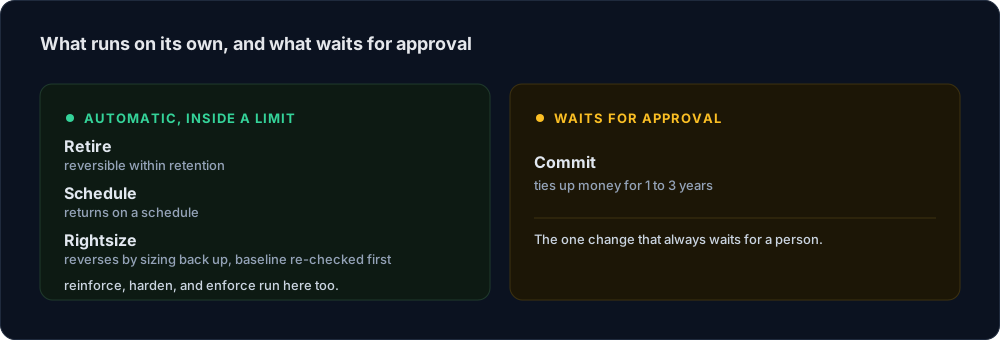
The line between what runs autonomously and what waits for approval is not arbitrary, and it warrants a plain statement. Retire, Schedule, and Rightsize are reversible, so they can run automatically within the limits you set: a spending ceiling, a blast-radius cap, and a baseline re-check that holds any change whose resource no longer looks safe. Commit ties up money over a multi-year horizon, so it always waits for a person to approve it. A well-designed system is explicit about which actions it took on its own and which it is only recommending. It never conflates the two, and it records every action in either category, so you can review exactly what changed, when, and why. Automation that cannot be audited is not a feature. It is an unacceptable risk.
Three more levers, beyond the bill
The levers so far remove waste. Three more do something different: they keep the estate sound rather than cheap, and they run on exactly the same loop. When a steady workload is running hot and heading for saturation, the operator reinforces it, adding a tier of headroom before the pressure becomes a slowdown or an outage. When a resource is opened to the whole internet, it hardens it, restricting access to the ranges that should reach it. When a resource drifts out of policy, untagged or unallocated, it enforces the policy and brings it back into line. None of the three carries a saving, so none is billed, but each runs on the same loop as the rest: watch a number, and act within the guardrails you set. The same operator that retires an idle disk to save money adds headroom to a saturating one, closes an exposed path, and tags a drifted resource, because operating the estate is broader than cutting its bill.
See it on your own estate
We connect to your accounts, map every resource inside them, and show you what PYXIS3 would operate and the savings it would realize in the first month, before you pay anything.
Book a demo